
Key Takeaways
- Your business structure affects taxes, liabilities, ownership, costs, and future growth.
- Sole trader, partnership, company and trust structures each offer different benefits and responsibilities.
- The right structure should consider both your current needs and long-term plans.
- Tax efficiency should be balanced with asset protection, control and compliance.
- You can change your business structure as your needs evolve, but tax and legal implications should be considered first.
What are the main types of business structures?
Your business structure determines how your business operates and can affect taxes, liabilities, ownership, and ongoing costs. Choosing the best business structure means considering where your business is today and where you want it to go.
The main structures used in Australia are sole traders, partnerships, companies, and trusts. Trusts can also take different forms, including family and unit trusts.
Australian Government guidance notes that your choice of structure can affect tax, asset protection, control, setup costs and ongoing administration.
Sole trader
A sole trader is one of the simplest ways to operate a business. You own and control the business yourself, with relatively low setup costs and fewer reporting requirements.
The trade-off is personal liability. You are legally responsible for the business's debts and losses, so your personal assets may be exposed if something goes wrong.
A sole trader structure can suit a smaller operation where one person wants full control, but it may become less suitable as the business grows or takes on more risk.
Partnership
A partnership structure involves two or more people running a business together and sharing its income or losses. It is generally relatively simple to establish, but the responsibilities and liabilities of each partner need careful consideration.
A clear partnership agreement can set expectations around ownership, decision-making, profit distribution and what happens if a partner leaves.
Liston Newton's partnership advice considers these obligations alongside the business's tax position and growth plans.
Company
A company is a separate legal entity from its owners. It can own assets, enter into contracts and incur debts in its own name.
This separation can provide greater protection from business liabilities than operating as a sole trader or general partnership. However, a company structure also entails higher setup costs, reporting requirements, and legal obligations. Directors can still be personally liable in some circumstances.
A company may suit a growing business that plans to employ more people, attract investors, retain profits or eventually bring in new owners.
Family trust
A family trust is generally a discretionary trust in which a trustee manages assets and distributes income or capital among eligible beneficiaries in accordance with the trust deed.
This structure can provide flexibility around distributions and help with asset protection, but it is more complex and costly to establish and administer than simpler structures.
A trust structure should be considered alongside your wider tax position, asset protection needs and long-term plans.
Unit trust
A unit trust divides beneficial interests in the trust into units. Unlike a discretionary family trust, each unitholder generally has a defined interest based on the units they hold.
This can make a unit trust useful where unrelated parties want to operate or invest together with clearly defined ownership interests.
As with other trusts, the trustee is responsible for operating the trust. The trust deed, ownership arrangements, tax implications and future plans should all be considered as part of the business structure setup.
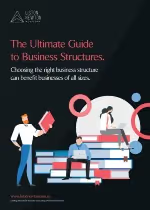
Choose a structure that supports your next stage with our free guide
The right structure can support your tax position, asset protection and future plans. Download our free guide to business structures, then book a strategy session to find the best fit for you.
How to choose the right business structure
The best business structure depends on more than what is easiest to set up. Consider tax, personal risk, ownership and how you expect the business to grow.
| Factor | Sole trader | Partnership | Company | Family Trust | Unit Trust |
|---|---|---|---|---|---|
| Setup and administration | Simple | Moderate | More complex | More complex | More complex |
| Ownership | One individual | Two or more partners | Shareholders | Trustee holds assets for beneficiaries | Trustee holds assets; investors hold units |
| Personal liability | Generally unlimited | Generally shared by partners | Generally limited, subject to director obligations | Depends on trustee structure and circumstances | Depends on trustee structure and circumstances |
| Tax treatment | Individual tax rates | Partners taxed individually | Company tax rates | Beneficiaries generally taxed on income allocated at the trustee’s discretion | Unitholders generally taxed on income according to their unit entitlements |
| Bringing in owners | Limited | Possible through partners | Flexible through shares | Limited suitability for outside investors | Through issuing or transferring units, subject to the deed |
| Growth potential | Can suit smaller operations | Can support shared ownership | Often suited to growth and investment | Can support family business growth and succession | Can support investment with defined ownership interests |
| Administration costs | Lower | Low to moderate | Higher | Higher | Higher |
The Australian Government notes that your structure can affect tax, personal liability, control, setup costs and ongoing administration. It can also be changed as the business develops.
Tax efficiency and asset protection
A tax-effective business structure should balance tax outcomes with risk and asset protection. Choosing a structure solely because it appears to offer a lower tax rate can create problems elsewhere.
For example, a sole trader is personally responsible for business debts and losses. A company is a separate legal entity, which generally creates greater separation between business and personal assets, although directors can still be personally liable in some circumstances.
Your structure should therefore consider what assets you hold, the risks involved in the business and how profits will be used or distributed.
Ownership, investors and employees
Think about who will own the business now and who may become involved later.
A sole trader gives one person full control. Partnerships allow ownership to be shared, while a company can accommodate multiple shareholders and changes in ownership through shares.
A company may also provide a more suitable framework where you expect to attract investors or expand your workforce. The Australian Government specifically identifies taking on investment, hiring employees and bringing in business partners as situations that may prompt a review of your structure.
Clear ownership structures can also reduce uncertainty about decision-making, profits and what happens when an owner joins or leaves the business.
Future growth and selling your business
Think beyond your current position when setting up a business structure. A structure that works today may become restrictive as revenue grows, new owners come in or you prepare to sell.
Structuring your business for growth can involve considering:
- How easily new owners or investors can enter
- How profits will be retained or distributed
- Whether assets are adequately protected
- The tax implications of future restructuring
- How ownership can eventually be transferred or sold.
The goal is not necessarily to choose a structure you will never change. It is to choose one that supports your plans without creating unnecessary cost or complexity.
How the right structure can help protect personal assets
This case study shows how the right business structure can help reduce personal exposure when financial challenges arise.
The challenge
Phil expanded his real estate agency using significant financing and personal guarantees, while holding valuable assets in his own name.
The solution
A stronger structure could have separated certain personal investments from business risks, including through a family trust with a corporate trustee.
The experience
After losing two major clients, revenue fell, and the business entered liquidation. Phil’s personal guarantees exposed his assets to business debts.
The highlights
- Significant business finance
- Personal guarantees
- Assets held personally
- Limited asset protection planning
The outcome
Phil had to sell personal and investment assets to help repay debts, highlighting the value of considering asset protection early.
The key takeaway
Asset protection is most effective when considered before financial problems arise. The right business and ownership structures can help separate personal wealth from business risks.
The key takeaway
Asset protection is most effective when considered before financial problems arise. The right business and ownership structures can help separate personal wealth from business risks.
How does tax change for different business structures?

Your structure affects how business income is reported, who pays the tax and which tax rate applies. Tax is therefore worth considering when you start a business, but it should be balanced with liability, ownership and future growth.
Tax paid as a sole trader or partnership
As a sole trader, your business profit forms part of your personal taxable income and is taxed at your applicable individual rate.
For example, if a freelance consultant earns $150,000 in business income and has $30,000 in deductible business expenses, their business profit would be $120,000. That amount is included in their personal taxable income, along with other assessable income.
A partnership works differently. The partnership lodges a tax return, but the partners generally pay tax on their respective shares of the net income.
For example, a partnership with $500,000 in income and $200,000 in deductible expenses has $300,000 in net income. If the partners share profits equally under a 50/50 partnership agreement, each would generally include $150,000 in their assessable income before considering their individual circumstances. Profit shares do not have to be equal. The partnership agreement may specify a different split, such as 60/40 or 70/30.
These structures can be relatively straightforward when you start small, but the tax outcome can change as income grows.
Tax paid under a company structure
A company is a separate taxpayer. It lodges its own tax return and pays tax on its taxable income, while employees and shareholders have separate personal tax obligations.
Under current ATO rules, a company that qualifies as a base rate entity is generally taxed at 25%, while the general company tax rate is 30%. A base rate entity must meet requirements, including aggregated turnover below $50 million and having no more than 80% of assessable income classified as base rate entity passive income.
For example, if an eligible base rate entity has $200,000 in taxable income, company tax at 25% would be $50,000, leaving $150,000 after company tax. However, this does not mean the owners can withdraw that $150,000 tax-free. Salary, dividends and retained profits can each have different tax consequences.
This is why choosing a company tax structure based on the company tax rate alone can give an incomplete picture.
Tax paid through a trust structure
Trust taxation depends on how income is distributed and who is entitled to it.
With a family or discretionary trust, the trustee can generally determine distributions among eligible beneficiaries in accordance with the terms of the trust deed. A unit trust typically distributes income according to each unitholder's fixed entitlement.
For a simple example, if a family trust has $200,000 of distributable income, the trustee may distribute different amounts among eligible beneficiaries rather than having one person receive the entire amount. The actual tax outcome depends on the beneficiaries, distributions and applicable tax rules.
The ATO states that beneficiaries are generally taxed on their share of a trust's net income in accordance with their entitlement, while the trustee may be taxed on income for which no beneficiary is presently entitled. Trust losses also generally remain within the trust rather than being distributed to beneficiaries.
This flexibility can make trusts useful in some circumstances, but the tax outcome should be considered alongside asset protection, control and administration costs.
Proposed changes to trust taxation
At the time of writing, the Federal Government has introduced legislation proposing a minimum 30% tax on the taxable income of discretionary trusts from 1 July 2028, subject to exclusions. The legislation has not yet passed, so the current rules continue to apply. If you operate through a family trust, speak with your tax advisor about how the proposed changes could affect your structure and future distributions.
Common business structure mistakes
Your choice of structure will depend on the size and type of business, ownership, risk and future plans. Common mistakes include:
Structuring your business for the short term
A sole trader is the simplest structure and is commonly used by small business owners, including consultants. The disadvantage is that you are legally responsible for the business and its debts.
Choose a business structure that can also support future growth, employees, and new owners.
Ignoring your personal structure
Your business structure should work with your personal assets, investments and financial situation. A company or trust, for example, can have different tax and asset-protection outcomes than operating personally.
No agreement when multiple owners are involved
In a partnership business structure or company, clear agreements can define ownership, responsibilities, profit-sharing, and what happens when someone leaves. Without one, disputes over decisions and business income can become harder to resolve.
Forgetting to do your research
Your structure affects tax, liability and compliance. Depending on your circumstances, you may need to register a business name, manage PAYG (pay as you go) obligations or register for goods and services tax (GST).
ASIC generally requires you to register your business name if you trade under a name other than your own legal name.
Structuring your business yourself
Choosing a structure is one of the important decisions you make when starting a business. Professional business structure advice can help you consider tax, liability, asset protection and growth before committing to one structure.
Can I change my business structure?

Yes. You can change your business structure if the existing one no longer suits the size, risk or direction of the business. However, moving from one structure to another can have capital gains tax implications, so consult your tax advisor before making any changes.
Why would I change my structure?
A change may make sense when your business grows, takes on more risk, brings in new owners or employees, or prepares for a future sale.
For example, a sole trader may transition to a company as the business grows and becomes more complex.
How to change business structures
The process depends on your current and new structures. You may need a new ABN, registrations, bank accounts and transfers of assets or contracts.
A trust business structure also requires a trustee, which may be an individual or a company.
Australian Government guidance notes that a change in structure may require a new ABN and updates to registrations, licences, and records.
Tax implications of changing structures
Transferring assets between structures can trigger CGT, GST and other tax consequences.
For trusts, trust net income may be distributed to beneficiaries, who generally include their share in their income tax return. In some circumstances, the trustee may instead be liable to pay tax.
Important things to consider before changing
Before restructuring, consider:
- Setup and ongoing costs
- CGT, GST and other tax implications
- Asset protection and liability
- Ownership and control
- Contracts and registrations
- Employees and PAYG obligations
- Future growth or sale plans.
Planning the change first can help avoid unnecessary tax, compliance and restructuring costs.
Who should give you advice on your business structure?
Choosing a structure for your business can affect tax, liability, ownership and future growth. Because these areas overlap, the right advice often involves more than one professional.
Accountants and professional business advisors
An accountant or business advisor can assess the structure against your business activity, tax position and wider financial situation or needs.
They can also model how different structures may affect income from the business, ongoing costs and future plans. This can be particularly useful when starting a new business, bringing in owners or restructuring an existing operation.
Lawyers, consultants and insurance brokers
Depending on the business, you may also need to consult other specialists.
A lawyer can advise on contracts, ownership agreements and legal risk. An insurance broker can assess appropriate cover, while specialist consultants may provide advice relevant to your industry or operations.
The aim is to choose one for your business that considers the legal, financial, and practical aspects, rather than focusing on tax alone.
Frequently asked questions
What is the best business structure for a small business?
There is no single best structure. A sole trader may suit a simple operation, while a company or trust may provide benefits as risk, income, or ownership becomes more complex. The right choice depends on your circumstances and future plans.
What is the best business structure for a consulting business?
A consultant may operate as a sole trader, a company or through another suitable structure. Consider expected income, liability, employees, asset protection and growth before deciding.
Do I need to register my business structure?
Requirements depend on the structure. For example, companies are registered with the Australian Securities and Investments Commission (ASIC), while tax registrations are generally managed through the Australian Taxation Office (ATO) and the Australian Business Register.
Your structure and activities determine which registrations and taxes you are required to pay or manage.
Get the right business structure advice from Liston Newton
With 50 years of experience, Liston Newton provides practical business structure advice that considers tax, asset protection, ownership and long-term growth. Our integrated accounting, tax and business advisory expertise helps you choose a structure that suits your current financial position while preparing for future owners, investments or an eventual exit.
We look beyond immediate tax outcomes to help you make informed decisions with greater clarity and confidence.
Table of contents