Our Locations
COVID-19: Liston Newton is here to support your business continuity planning. Get started

Our new head office is now in South Melbourne - See address

Call us today



With over 40 years of experience behind us, our professional business accountants are true experts. And we are always aiming for greater achievements.

We provide a full range of large, medium and small business accounting services, from business advisory to financial consultancy.

We're not just impersonal business accountants — we can help you set your wealth goals and give you the best foundation for success.

We are at the forefront of industry innovation. We use the latest technology to deliver high-quality services for all our clients.
We’ve placed the solutions to all of your needs under one roof. Whether you’re a state-spanning corporation or a regional small business, our accountants will help you with everything from accounting optimisation to tax minimisation.



Business Activity Statements require a meticulous eye for detail to complete. Let’s be honest: they can be a headache that demands more attention than many business owners can spare. Let us handle your BAS obligations for you.
Our professional team of BAS accountants will ensure that your statements are correct and lodged on time. We’ll also ensure that what is declared in your BAS return matches all your BAS lodgements.
To ease your mind, we’ll provide you with an ATO audit guarantee; should the authorities find an issue with your statements, we will resolve the issue on your behalf — for free.
If you’re interested in setting up an Australian subsidiary of your foreign-owned company, our business accountants will help you build a rock-solid foundation.
We're a specialist accounting and business advisory firm with years of proven experience working with overseas companies like yours.
We can guide you through all aspects of Australia's tax system, including your obligations and minimisation strategies and your ASIC, ABN, and TFN obligations. We will also assist you through the business registration process and counsel you on day-to-day financial operations.

We’ve earned our laurels from major Australian and international accounting institutions.
Kieran Liston and the Liston Newton team have been assisting me with my accounting matters since 1976. For the past 47 years, Kieran and the Liston Newton team have provided reliable accounting assistance, which has allowed me to focus on my business in primary production.
Their exceptional service has consistently exceeded my expectations and made me feel that they truly care about my financial well-being.
Liston Newton has given me really helpful guidance over the years for both my business and my personal finances. When you have an accounting team that you trust to give the right advice, it gives you the confidence to focus on growing your business and doing the things you love.
Liston Newton helped us move our accounting over to Xero. Their Accountant managed the set up and training so we felt comfortable with the software. We now have all our processes streamlined which gives us improved visibility of our business performance. This has allowed us to open 2 more stores without a significant increase in administration effort.
At Liston Newton Advisory, we take pride in helping business owners get more out of their hard work. Our downloadable guides can give you an in-depth look at strategies and technologies that will help your business grow.
If you read something you’d like to learn more about, book a free consultation and let’s have a chat.
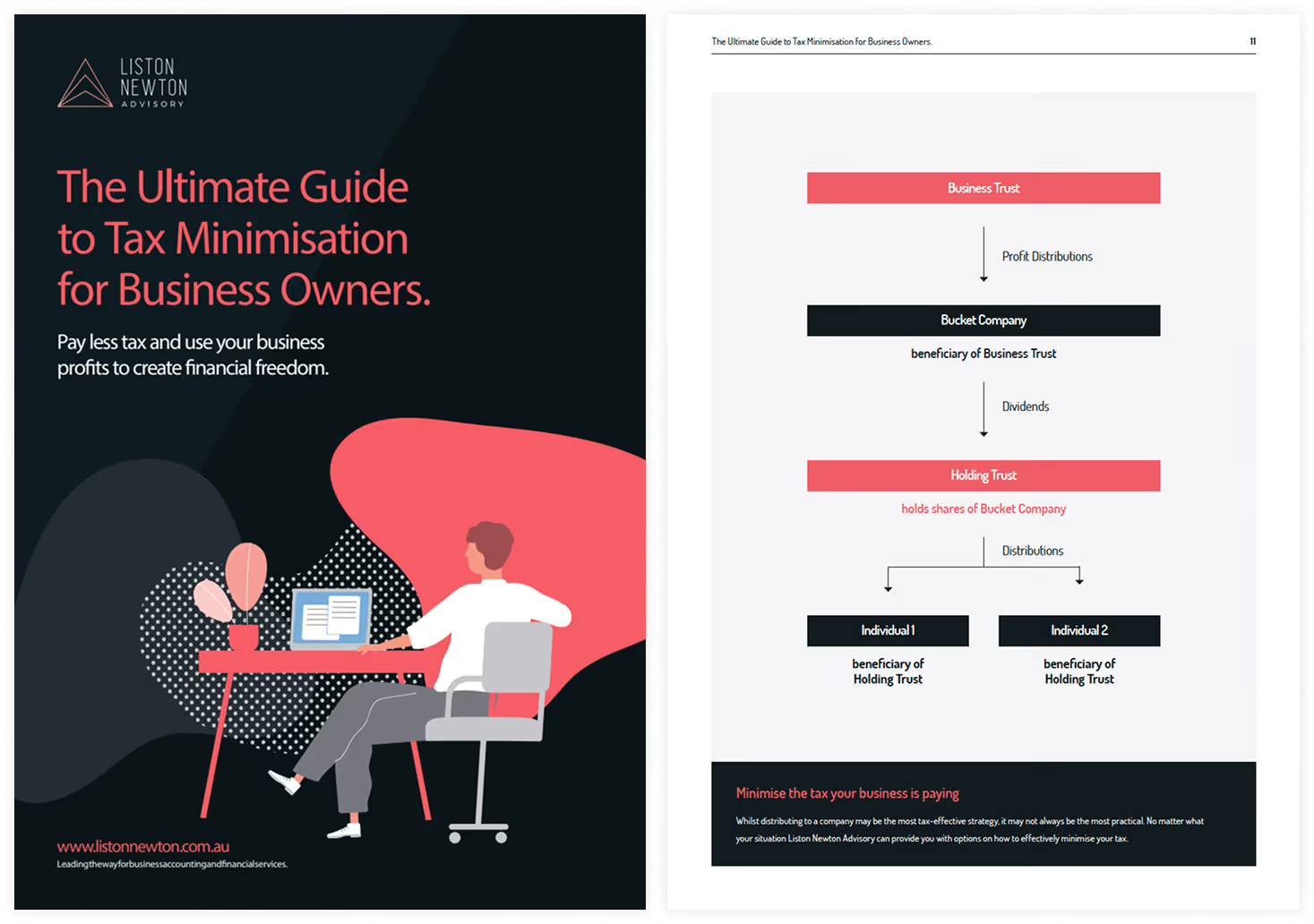
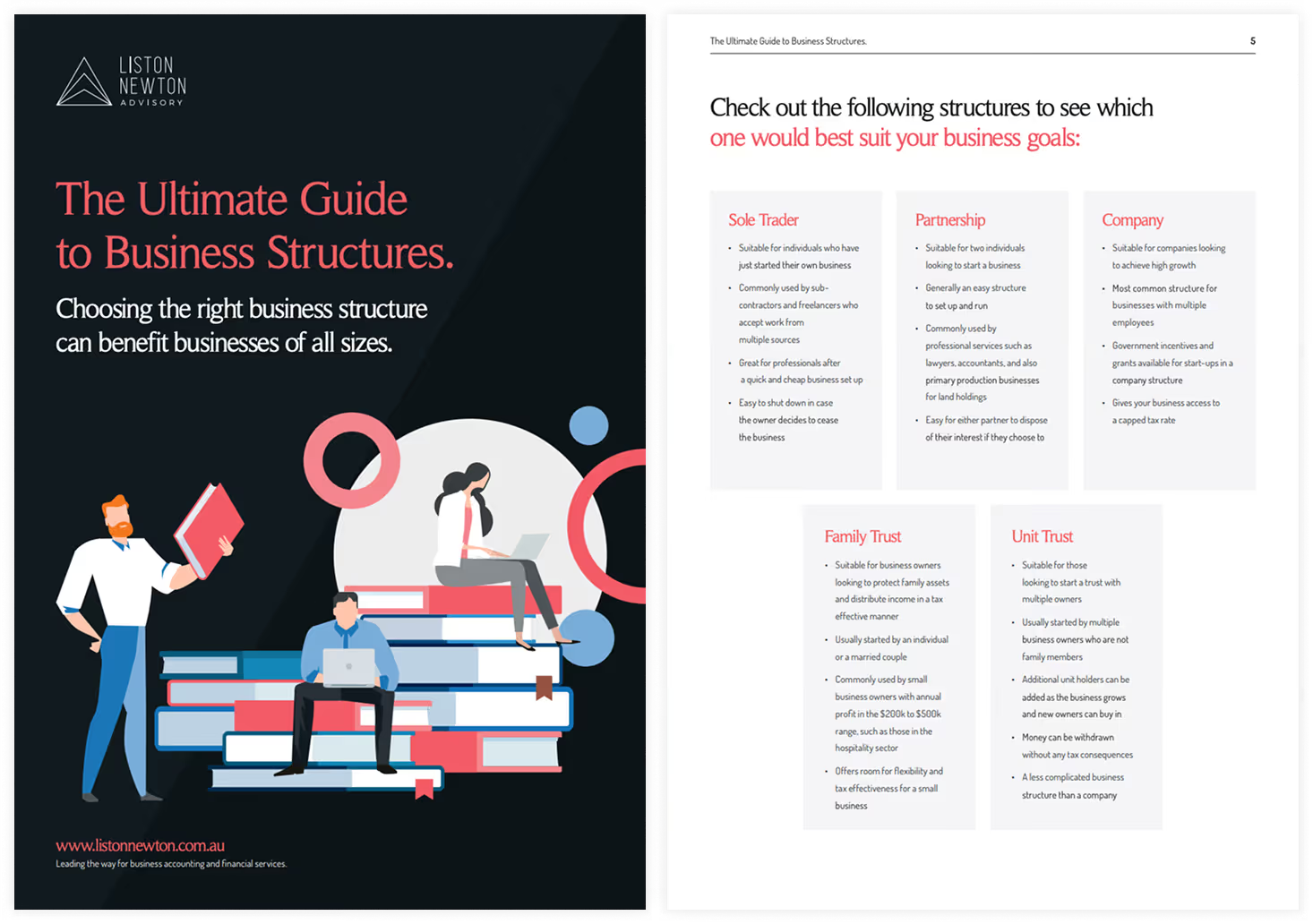
At Liston Newton Advisory, we take pride in helping business owners get more out of their hard work. Our downloadable guides can give you an in-depth look at strategies and technologies that will help your business grow.
If you read something you’d like to learn more about, book a free consultation and let’s have a chat.
We’re cautious about taking on new clients. Our diligence isn’t just about vetting new business, but also about ensuring we have the capacity to dedicate our time and resources to every client’s success.
So, here is our guarantee to you: you won’t ever be put on the back burner. Your needs and ambitions are no less important to us than those of our other clients.
We have developed a unique approach to accounting. All our services are part of an overall strategy designed to move your business through the different stages of growth. We call our method Get Set, Get Moving, Get Free.
We’ll begin with a consultation to define your ambitions and an audit to bolster your foundation.
We’ll optimise, systematise and automate processes to move you towards your goals.
Our wealth-creation strategies will help you plan and execute long-term strategies for total financial freedom.


We have helped Cambridge Plumbing to manage and forecast cash flow. We've also provided the director with advice on wealth creation and asset allocation.
Take a lookWe restructured Papermill Media and moved them to cloud accounting. Papermill was listed at number 43 in the Australian Financial Review's Fast 100 List in 2017.
Take a lookAfter helping them transition to Xero, we conducted quarterly business coaching with Quality Energy and helped increase their profits by 90 per cent.
Take a lookWe have six offices across the east, from which we can provide accounting services for metropolitan and regional businesses alike. Rest assured that our services are available to you no matter what state or territory you’re based in, and we’ll gladly make the trip over for a handshake, coffee and a consultation.


An audit of financial reports is a regulatory requirement for the following:
Another factor that causes an audit is whether a company or charity receives a government grant. The audit proves to the government that the figures in the financial reports are true and fair.
First, you need to consider why you're hiring a business accountant over any other type of accountant.
Internally, business accountants are usually a significant expense and are only employed in large-scale established businesses. However, if you’re a small business owner, you’ll find a dedicated business accountant just as necessary. We recommend assessing whether the tasks could be better delegated internally before hiring an external business accountant. Liston Newton Advisory is an expert small business accounting service; get in touch with us today for a free strategy session.
Liston Newton is a highly experienced small business accounting firm. We can help you achieve your financial goals by preparing budgets and managing your cash flow effectively. Our cloud-based accounting technology will allow you to get invoices paid faster, collaborate remotely with accountants, and protect your data with multilayer security.
We've been a small business ourselves, so we know what it takes to grow a successful small business.
According to legislation, it is the business owner's responsibility to record and report how much GST your business has received and paid.
If your business revenue is over $75,000 per annum, you must lodge a BAS every quarter. If your revenue is over $20 million per annum, you must lodge a BAS every month.
Yes, you can. However, we don't recommend this for growing businesses. It's easy to make costly mistakes if you aren't up to date with legislation and don't have the correct training.
As a business owner, handling your own BAS isn't the best use of your time. Instead, you could be focusing your time and energy on running and building your business.
If you cannot pay your BAS lodgement when it is due because of cash flow issues, you may be able to organise a payment plan with the ATO. We can speak to the ATO on your behalf and arrange this for you.
Firstly you will need to determine the appropriate structure for your Australian business. Most foreign-owned entities opt for a company structure – and when setting up a company in Australia, at least one director must be an Australian resident for tax purposes.
Once the structure is in place, you must get your registrations in order. This means getting an Australian Business Number (ABN), investigating if you need to register for goods and services tax (GST), and registering for a tax file number (TFN).
Read more details on setting up an Australian company here.
This is an important question, as non-resident businesses will generally be taxed on income with an Australian source, while Australian resident entities are taxed on their worldwide income.
Most non-resident businesses operate in Australia through a company structure. A company only becomes a resident if it's incorporated in Australia, conducts its business in Australia and is controlled by Australian residents, or has Australia-based management.
For full details, visit the ATO website.
A thinly capitalised entity is funded by a large amount of debt and very little equity. Due to the large amount of debt, there is potential to claim large tax deductions for interest payments on that debt.
Some foreign-owned entities will attempt to lower their taxes in Australia by creating loans to Australian businesses and using the interest payable as a deduction. The interest income is then recognised in another tax jurisdiction.
Like transfer pricing, the ATO closely watches thin capitalisation to ensure that profits are not shifted away from an Australian entity to another country with lower tax rates.
Simply leave us your details, and we’ll be in touch.


Powered by EngineRoom
Get a free 60-minute video consultation. See how it works.
%20160x160.avif)








.avif)




.avif)
.avif)